


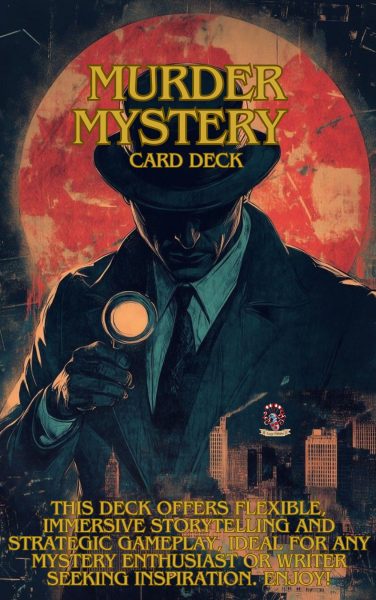
Murder Mystery
Card Deck
€29.99
The Deck Components
The deck consists of 60 cards divided into several categories:
Suspect Cards (10 cards) - Each card features a suspect with a brief description and possible motive.
Example: Card Name: Lily Stone - "A painter known for her temper. Rumored to have had a falling out with the victim over a portrait."
Location Cards (10 cards) - Each card depicts a location where the crime may have occurred or where clues can be found.
Example: Card Name: Library - "Where the victim was last seen alive. Known for its hidden passages and dim lighting."
Motive Cards (10 cards) - Potential reasons for the murder, ranging from betrayal to hidden secrets.
Example: Card Name: Revenge - "The victim wronged the suspect in the past. This could be an act of retribution."
Weapon Cards (10 cards) - Possible murder weapons, such as a candlestick, rope, or poison.
Example: Card Name: Poisoned Drink - "The victim was found with a glass of wine, which could have been tainted."
Clue Cards (15 cards) - Hints, evidence, and red herrings, helping players eliminate options and narrow down the investigation.
Example: Card Name: Torn Photograph - "A photograph found near the crime scene, torn in half."
Event Cards (5 cards) - Unexpected events that can hinder or help the investigation, such as an alibi, sudden clue revelation, or an obstacle.
Example: Card Name: Witness Testimony - "A witness emerges with a shaky alibi for one of the suspects."
Game Setup
Shuffle each category separately, then place them face down in five distinct piles: Suspects, Locations, Motives, Weapons, and Clues.
Create the Mystery:
Draw one card each from the Suspect, Location, Motive, and Weapon decks to form the crime. Set these aside face down (without revealing) as the secret crime. This is the combination players must deduce.
Deal the Cards:
Each player receives 2-3 cards from the Clue deck. These are kept hidden.
Place the remaining Clue cards face down in a stack accessible to all players.
Game Rules
Turns: Players take turns drawing one card from any deck they choose. They may choose based on what category they need more information on (e.g., if they lack motive clues, they may draw from the Motive deck).
Reveal and Interpret: After drawing, players reveal their card and discuss its implications. All cards remain visible in front of each player for reference.
Clues and Deduction:
Players may share their cards and discuss theories to eliminate possibilities. Clue cards can help confirm or rule out aspects of the crime, while Event cards can change the game flow.
Each time a player draws a clue that matches a known element, it strengthens that deduction. For example, if a weapon clue matches the Weapon deck, it’s likely to be the murder weapon.
Making Accusations:
After a few rounds, players may attempt an accusation by guessing the exact suspect, location, motive, and weapon. Players must have drawn at least one card from each deck to make a valid accusation.
If correct, they win and reveal the “crime” cards; if incorrect, they are eliminated from the round (though they may continue helping others).
Winning: The first player to accurately deduce the four elements of the mystery wins. For solo play, the goal is to use the clues to draft a unique crime story.
Using the Deck for Story Inspiration
Character Development: Draw a Suspect and Motive card to create character backstory and motives for your mystery.
Scene Setting: Use Location cards to visualise the environment where the mystery unfolds. Add ambiance based on the location, like eerie silence in a library or a loud crowd in a ballroom.
Plot Twists: Draw Event and Clue cards to add unexpected plot twists or side stories that deepen the mystery and lead your protagonist astray before finally solving the case.
Example Round Playthrough
Player A draws from the Suspect deck: Lily Stone.
Lily, the painter, is now part of the suspect pool.
Player B draws a Location card: Library.
They discuss how the library’s dim lighting could hide a criminal act.
Player C draws a Motive card: Revenge.
Lily’s rumoured falling out with the victim fits the motive of revenge, narrowing down potential suspects.
Player D draws a Clue card: Torn Photograph.
They hypothesise that the photograph might connect Lily to the library or another suspect.
Players continue in this way until they believe they have enough evidence to make an accusation or to write a thrilling crime story!
This deck offers flexible, immersive storytelling and strategic gameplay, ideal for any mystery enthusiast or writer seeking inspiration. Enjoy!